
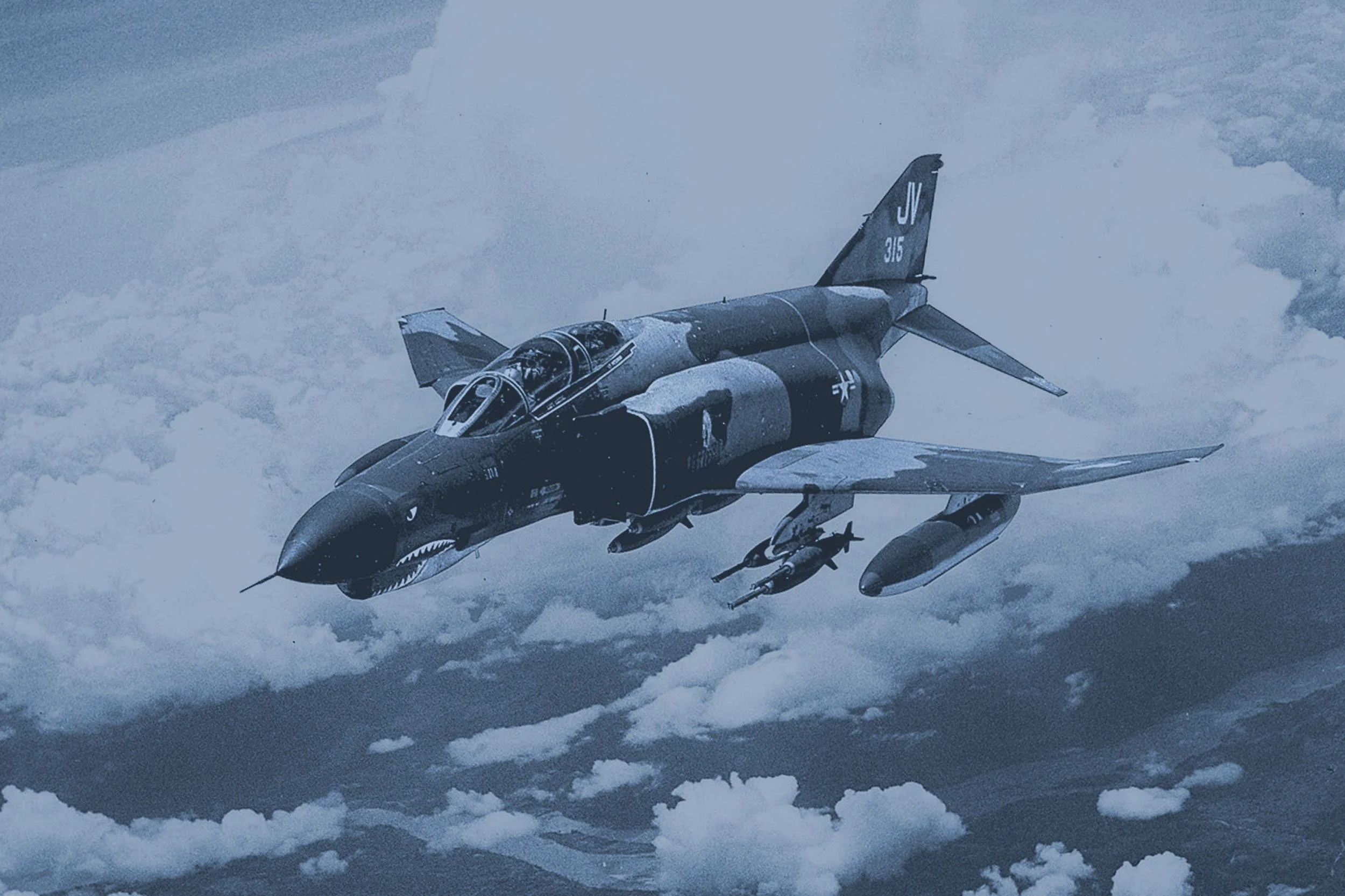
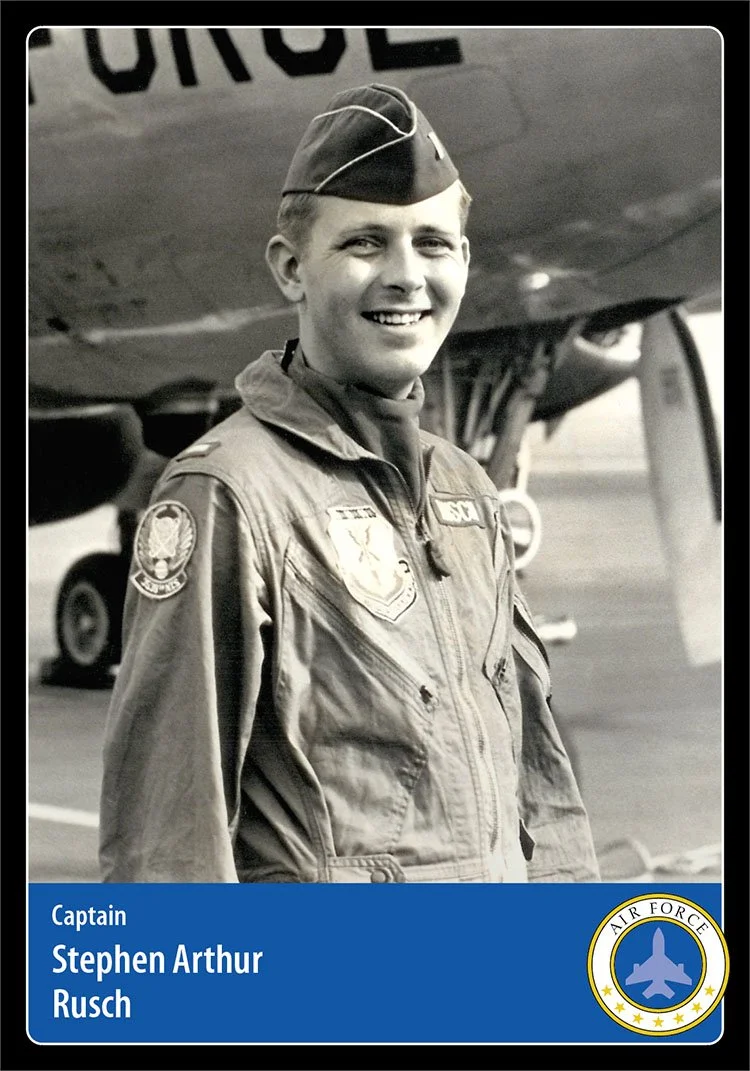
Hero Card 291, Card Pack 25 [pending]
U.S. Air Force photo VIRIN: 071207-F-7301C-003 (digitally restored), Public Domain
Hometown: West Amwell, NJ
Branch: U.S. Air Force
Unit: 4th Tactical Fighter Squadron, 366th Tactical Fighter Wing, Seventh Air Force
Military Honors: Distinguished Flying Cross with Oak Leaf Cluster, Air Medal with six Oak Leaf Clusters, Purple Heart
Date of Sacrifice: March 7, 1972 - KIA in Salavan Province, Laos
Age: 28
Conflict: Vietnam War, 1959-1975
According to The Times of Trenton, New Jersey, Stephen’s father, Hugo “Hugh” Rusch, was an engineer who invented the hydraulic transmission, the electro-hydraulic motor, and a graphic recording instrument for measuring radio and television audience size.
Hugh and Cynthia (Van Tuyl) Rusch raised Stephen, along with older brother Willard and younger sister Cynthia, just outside of Lanbertville—a small New Jersey community located roughly halfway between Philadelphia, PA, and New York City.
Stephen graduated with the class of 1961 from the Hun School in Princeton, NJ—a private boarding school 17 miles east of Lambertville. While in high school, he worked as a lifeguard at Pretty Brook Tennis Club.
After high school, Rusch attended Rutgers and Drew Universities. While at Drew, he met his future wife, Judy Tomlinson, where both studied math.
Stephen was a gifted musician, playing guitar and banjo, and composing folk tunes. He played gigs at local coffeehouses in New Jersey and in Greenwich Village, New York City.
Judy recalled, “He really caught my eye…he was tooling around in a 1954 MG [British roadster], a beautiful car.” After Judy completed her junior year at Drew, the two married and would later welcome two daughters: Sharon and Rebecca.
Serving his country
As the war in Vietnam grew more intense, Stephen enlisted in the United States Air Force—rather than waiting to be drafted into the service. At the time, it was advantageous to enlist because it allowed you to choose your military branch and occupational specialty, which would otherwise be left to chance.
Life for a military family meant frequent moves. Rusch’s duties took the family to Syracuse University for Air Force language specialist training, training at Keesler Air Force Base in Biloxi, Mississippi (where Sharon was born), training at Ramey Air Force Base in Puerto Rico (where Rebecca was born), Officer Training School at Lackland Air Force Base in San Antonio, Texas, and training as an avionics officer at Lowry Air Force Base in Denver, Colorado.
Military life took a toll on the family. Stephen and Judy would divorce in 1969 but remained friends. In fact, while he was deployed, Stephen wrote letters home to Judy and the girls nearly every day.
Deploying to Vietnam, Rusch was assigned to the 366th Tactical Fighter Wing’s 4th Tactical Fighter Squadron at Da Nang, Republic of Vietnam (South Vietnam).
There, he flew bombing missions twice each day as a weapons systems officer. In a letter home, Rusch described his duties:
Dear Judy, Sharon, and Becky,
I’m what they call the Weapons System Operator in the back seat of [an] F4-E Phantom fighter jet. What we’re really called is a GIB (for “guy in the back”). Aside from being responsible for navigation, we do just about everything the pilot does. We can carry just about any type of weapon made, but a normal load would be about 3 tons of bombs or napalm. We generally release that at speeds ranging from about 400 to 600 knots. The ground really comes up at you pretty fast.
I usually fly about twice a day, which is quite exhausting. There is no such thing as a day off – we work 7 days a week, all year. It does make the time go faster, however.
Be good.
Steve
Final mission
On March 7, 1972, Rusch was aboard an F-4E Phantom II fighter-bomber (tail number 69-7552, call sign “Gunfighter 61”). He and his pilot, 1st Lt. Carter A. Howell, were on a reconnaissance mission about 25 miles east of Ban Toumlan in Salavan Province—a rural, mountainous jungle region in southern Laos.
Rusch and Howell flew the number two aircraft in a flight of two. Col. Don Rakestraw was piloting the lead fighter jet, “Gunfighter 60,” and his report describes what took place on that mission:
On the 7th of March, 1972 Gunfighter 60 and 61 departed DaNang AB [Air Base] to search for trucks moving early in the morning on the route structures of Southern Laos. We sighted two trucks and called them out to Stephen’s aircraft, which also had the trucks in sight. He called he was rolling in on the target. A few seconds later, we noticed muzzle flashes on the ground and tracers from a triple-A gun going right across what appeared to be Stephen’s flight path. I then saw a bomb explode and right after that, I saw Stephen’s aircraft hitting the ground. In my estimation, Stephen’s aircraft was hit by ground fire, which disabled the crew, and they went in with the aircraft.
The lead aircraft attempted radio contact without success and conducted an immediate search. No parachutes were seen, and no emergency beepers were heard to indicate the Gunfighter 61 crew was safe. Later searches in the area were also unsuccessful. Rusch and Howell were officially declared missing in action.
Search for answers
Rusch’s daughter, Rebecca, was three years old, and his daughter Sharon just celebrated her sixth birthday when they were told that their father’s aircraft had been shot down halfway around the world. His fate would not be known for another 35 years.
According to the U.S. Air Force’s Air Combat Command:
In 2001, a Laotian citizen, working through a U.S. acquaintance, gave U.S. officials a bone fragment and a photocopy of military identification tags. While the tags belonged to Captain Rusch, the bone fragment did not.
The team excavated the crash site two times throughout 2002 and 2003, recovering human remains and non-biological evidence including U.S. coins and life support equipment.
Remains recovered from the crash site in 2002-2003—just two teeth—were positively identified on June 26, 2007.
Coming home
On November 30, 2007, Capt. Stephen Arthur Rusch was laid to rest with full military honors at Arlington National Cemetery, across the Potomac River from Washington, D.C. (Section 64, Site 5886). He is honored at the Vietnam Veterans Memorial in Washington, D.C., where his name is inscribed on Panel 2W, Line 113.
In Honolulu, Hawaii, Capt. Rusch’s name is engraved on the American Battle Monument Commission’s “Courts of the Missing,” (Court A, Panel 138). As is the custom, a rosette was placed next to his name to indicate that he has been found.
Legacy
Despite her tremendous loss at a young age, Capt. Rusch’s daughter Sharon also chose to serve in the U.S. Air Force. She rose to the rank of Major General and served her country, in uniform, for 31 years. She served as an Air Force dental officer and was able to confirm, without a doubt, that the two recovered teeth were a match for her father’s dental records.
In 2017, an Emmy Award-winning documentary—entitled Blood Road—followed daughter Rebecca’s 1,200-mile cycling journey along the infamous Ho Chi Minh Trail, attempting to reach her father’s crash site.

Sources
Story details contributed by retired Maj. Gen. Sharon Bannister, Capt. Rusch’s daughter.
Defense POW/MIA Accounting Agency: Capt. Stephen Arthur Rusch
Red Bull Media House: Blood Road (video documentary)
The Evening Times, Jul. 28, 1965: Latest News Of Servicemen From The Delaware Valley Area
The Evening Times, Feb. 21, 1966: News Of Servicemen
The Evening Times, Sep. 17, 1969: In The Service
U.S. Air Force Air Combat Command: Gunfighter missing in action identified
New Jersey Vietnam Veterans’ Memorial & Museum: Stephen Rusch - Captain
Vietnam Veterans Memorial Fund—Stephen Rusch
The Star-Ledger, Nov. 28, 2007: Two teeth solve the 35-year mystery of a Jersey MIA
Air Force Medical Service: Echoes of Vietnam: An Air Force family legacy
Case Western Reserve University, THINK Magazine: Lives of Service
Burial Site: Find a Grave

