

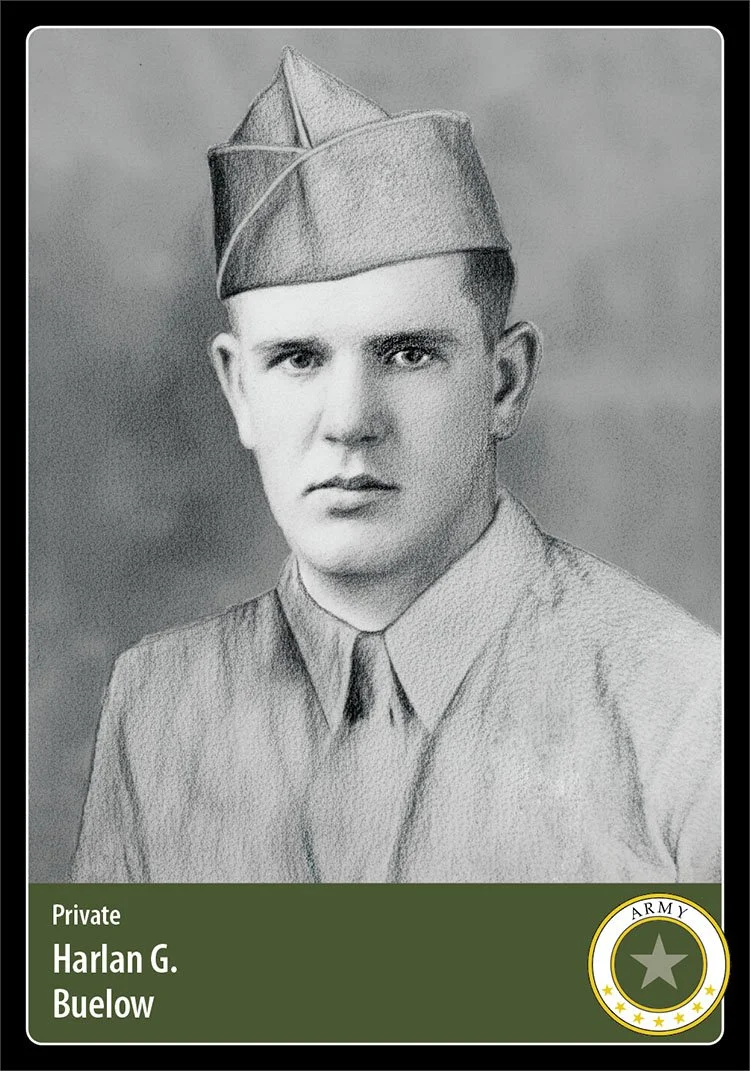
Hero Card 292, Card Pack 25 [pending]
Artist’s rendering by Craig Du Mez, from original photos
Hometown: Mazomanie, WI
Branch: U.S. Army (Air Forces)
Unit: 14th Bomber Squadron, 7th Bomber Group (Heavy)
Military Honors: Prisonor of War Medal, Purple Heart
Date of Sacrifice: April 15, 1943 - KIA in Tokyo, Japan, POW camp
Age: 22
Conflict: World War II, 1939-1945
Harlan George “Buff” Buelow grew up in the rolling hills of southwestern Wisconsin’s Driftless Area. His parents, George and Ethel (Talbot) Buelow, were dairy farmers who had moved to Wisconsin from South Dakota. George later worked as a gas station attendant.
Harlan was their only son and became a star athlete at Mazomanie High School. He graduated with the class of 1938, the same year that his mother, Ethel, passed away.
After high school, Harlan found work with the Civilian Conservation Corps (CCC), working on timber stand improvement in northern Wisconsin. The National Parks Service describes the CCC:
As part of the New Deal Program, to help lift the United States out of the Great Depression, Franklin D. Roosevelt established the Civilian Conservation Corps in 1933. The CCC or C’s as it was sometimes known, allowed single men between the ages of 18 and 25 to enlist in work programs to improve America’s public lands, forests, and parks.
For many, just the prospect of three meals and a bed were enough to get young men to enroll. As jobs and income were incredibly scarce, the CCC for a lot of these young men was their first job. Enlisters would make $30 a month, $25 of which would be sent straight to their families, while the other five was for the worker to keep. Meals and lodging were provided in military camp fashion.
Perhaps influenced by his father, who was a World War I Veteran, Harlan traveled to Milwaukee on November 19, 1940, to enlist in the United States Army.
He was sent to Pearl Harbor, Hawaii, and later stationed in the Philippines with the 14th Bomber Squadron, 7th Bomber Group (Heavy), Army Air Corps.
At the time, trouble was brewing around the world as hostile nations in Europe and Southeast Asia were seizing neighboring countries. The people of the United States were reluctant to get involved in another foreign conflict, but the government had begun to prepare for war.
Private Harlan Buelow was in the Philippines when Imperial Japan executed a surprise attack on the U.S. Pacific Fleet at Pearl Harbor on Dec. 7, 1941. The next day, Congress passed a declaration of war against Japan. Three days later, Nazi Germany and Italy—allied with Japan—declared war on the United States.
The Philippine Islands were of critical importance for both Japan and the United States during World War II. Whoever held the Philippines controlled crucial supply lines for the Japanese war effort. And the United States would need the islands’ airfields for any direct assault on Japan itself.
Japan fought to remove the American presence in the Philippines—finally succeeding with the surrender of the island of Corregidor on April 9, 1942.
American forces, including Pvt. Harlan Buelow, were taken prisoner by the Japanese and moved to POW (Prisoner of War) camps in and around Japan.
Treatment of American POWs was harsh, with many being malnourished, beaten, and killed. Little communication with the outside world was allowed. Pvt. Buelow was taken to a POW camp in Tokyo, Japan—the empire’s capital city. At some point while in Tokyo, Buelow was hospitalized for beriberi.
For 13 months, George Harlan heard nothing from his son, Harlan. Then on June 7, 1943, the War Department confirmed that Pvt. Buelow had been taken prisoner by the Japanese.
Six weeks later, George received a letter from Harlan in the form of a card, dated December 12, 1942. According to the Wisconsin State Journal, “The card was of cheap crude paper, shabby and soiled. [Pvt.] Buelow stated that he was safe in Japan, and usual health, and that he had not heard from home since November 1941.”
Two weeks later, George received a telegram from the War Department—through the International Red Cross—notifying him that his son had died in a Japanese prison camp.
Pvt. Harlan G. Buelow was posthumously awarded a Prisoner of War Medal and the Purple Heart Medal. He is buried in the Manila American Cemetery in the Philippines (Plot E, Row 4, Grave 32).
In his hometown of Mazomanie, Wisconsin, the Greening-Buelow American Legion Post 437 was named in his honor.

Sources
Artist’s rendering by Craig Du Mez, from original photos
Greening-Buelow American Legion Post 437: American Legion Post #437 Honors Mazomanie WWII Hero
Wisconsin State Journal, July 28, 1943: Prisoner in Japan Writes to Father in Mazomanie
Wisconsin State Journal, August 9, 1943: Harlan Buelow, Mazomanie, Dies in Tokyo Prison Camp
The Capital Times, Aug. 7, 1943: Mazo Athlete, Prisoner, Dies
U.S. Army Airborne & Special Operations Museum: What Happened During the Battle of Corregidor?
HonorStates.org: Harlan G Buelow
Burial Site: Find a Grave

