

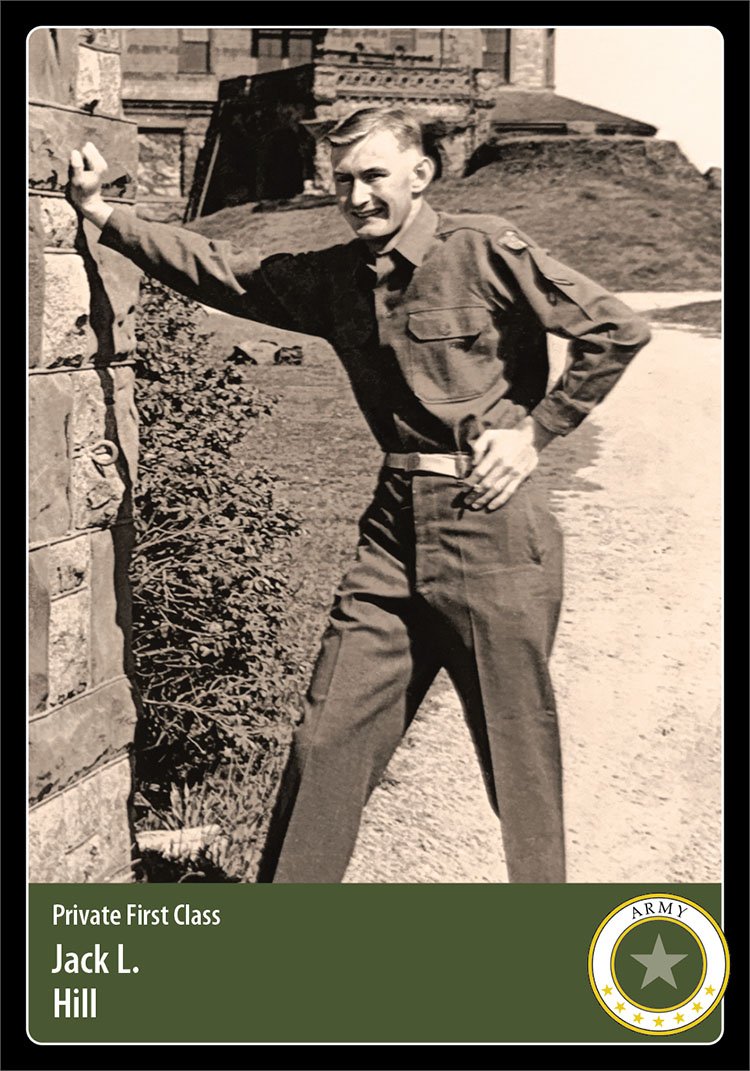
Hero Card 293, Card Pack 25 [pending]
Photo credit: Photo (digitally enhanced) provided by the family.
Hometown: Jefferson City, TN
Branch: U.S. Army
Unit: Company I, 5th Infantry Regiment, 71st Infantry Division
Military Honors: Purple Heart
Date of Sacrifice: March 25, 1945 - KIA near Lingenfeld, Germersheim, Rhineland-Palatinate, Germany
Age: 22
Conflict: World War II, 1939-1945
Jack Leon Hill was born on January 7, 1923, on a farm that his grandfather purchased near Jefferson City, Tennessee. Jack was the oldest of four children born to parents James “Walter” and Lucy (Hudson) Hill—with younger sisters Lena and Margaret and younger brother Blair.
The Hill children had four older half-siblings—Joella, Juanita, Hazel, and Clayton—from Walter’s previous marriage that ended with the death of his first wife, Nell.
According to the family, Jack was a practical joker who loved farming. As a boy, he also worked as a newspaper carrier for The Knoxville Journal.
During his junior year at Jefferson City High School, Jack responded to an advertisement from the Tennessee Valley Authority (TVA), which played a significant role in supplying electrical power for the nation’s essential war industries.
Many good jobs became available with the construction of hydroelectric dams to harness the power of the Tennessee River system. According to the TVA:
Taking up the cause, TVA engaged in one of the largest hydropower construction programs ever undertaken in the United States. Early in 1942, when the effort reached its peak, 12 hydroelectric projects and a steam plant were under construction and design, and engineering and construction employment reached a peak of 28,000.
Jack left school to seize the employment opportunity and remained with the TVA through the completion of the Cherokee Dam.
With the United States fully engaged in World War II, Jack registered with the United States Army on February 2, 1943, at age 20.
Hill was sent for Basic Training at Fort Bragg, North Carolina. He was assigned to Company I, 5th Infantry Regiment, 71st Infantry Division (nicknamed the “Red Circle”). His training included transfers to Fort Benning in Columbus, Georgia, and Fort Adams in Newport, Rhode Island.
Some 50 years after their service, fellow soldier and close friend Robert Potts wrote to PFC Hill’s family with recollections of their deployment. According to Potts, the 71st Infantry Division received orders to ship out to the European Theater in January of 1945 and was transported to Camp Kilmer in New Jersey for staging. Potts recalled:
In the evening of January 27 [1945], we were transported to Staten Island, New York, where we boarded our ship which sailed in the dark early hours of January 28 in order to avoid any subs that might be lurking just offshore. Our ship joined a very large convoy which proceeded to cross the Atlantic. As you can imagine, we were very crowded with bunks just inches apart. The next eight days we spent playing cards and watching dolphins race alongside the ship.
PFC Hill’s 71st Infantry Division landed in Southampton, a port city on England’s south coast, on February 5, 1945, then crossed the English Channel in the early hours of February 6 to arrive at the French city of Le Havre. Robert Potts remembers, “the regular docks had all been blown up, so we had to disembark at floating docks that had been improvised.”
The newly arrived troops spent the next month at Limésy, France, preparing for the Allied campaign to push Hitler’s Nazi Army back through Germany all the way to Berlin.
In early March of 1945, PFC Hill’s unit broke camp and made its way across France, arriving at the city of Saint-Louis and the Rhine River—France’s border with Germany.
Hill’s regiment was assigned to the XV Corps serving under the U.S. Seventh Army. According to Robert Potts, their task was to take the bridge over the Rhine located in Germerscheim, Germany—preventing the German Army from keeping it as a means of withdrawal.
Potts describes part of that battle that took place near the small town of Lingenfeld:
Our objective on that day [March 25, 1945] was to advance through the town and to neutralize any enemy forces we found therein. It was early afternoon, and as we came to the middle of town, sniper fire erupted.
Several men were dispatched to root out the sniper and after that everything was peaceful and we continued on. We had come almost all the way through town with only one line of houses to go [and] thought we had just about completed our uneventful mission when suddenly the world exploded.
The area around the last line of houses was under intense fire from machine guns, burp guns [MP 40 submachine guns] and rifle fire. Since here was no cover other than the last line of houses—which, by the way, were still under construction—everyone ran for the nearest house.
As soon as I got in one of the houses, I started looking around, Jack who had been about a hundred feet to my left was down, a sergeant by the name of Miller had been about the same distance or a little more to my right was also down.
Because intense enemy fire made it impossible to reach the fallen men, Potts waited for the cover of darkness to crawl out to them. Reaching PFC Hill, he touched his shoulder and whispered his name.
“It was apparent that Jack never knew what hit him and that nothing could be done for him,” Potts recalled.
Less than a month after joining the fight in Europe, PFC Jack L. Hill was lost at age 22. He left home, family, and friends to help liberate Europe from Nazi Germany. The war in Europe ended on May 8, 1945, just three months after Hills’s arrival in France.
PFC Hill was returned home and laid to rest in the spring of 1949.

Sources
Card photo and story details contributed by the family.
East Tennessee Veterans Memorial Association: Jack L. Hill
Dandridge Banner, Nov. 11, 1943: With Our Boys in the Service
Jefferson County Standard, Feb. 10, 1944: With Our Boys in the Service
The Knoxville Journal, May 21, 1944: Uncle Sam’s Boys
United States Holocaust Memorial Museum, Holocaust Encyclopedia: The 71st Infantry Division During World War II
Burial Site: Find a Grave

