

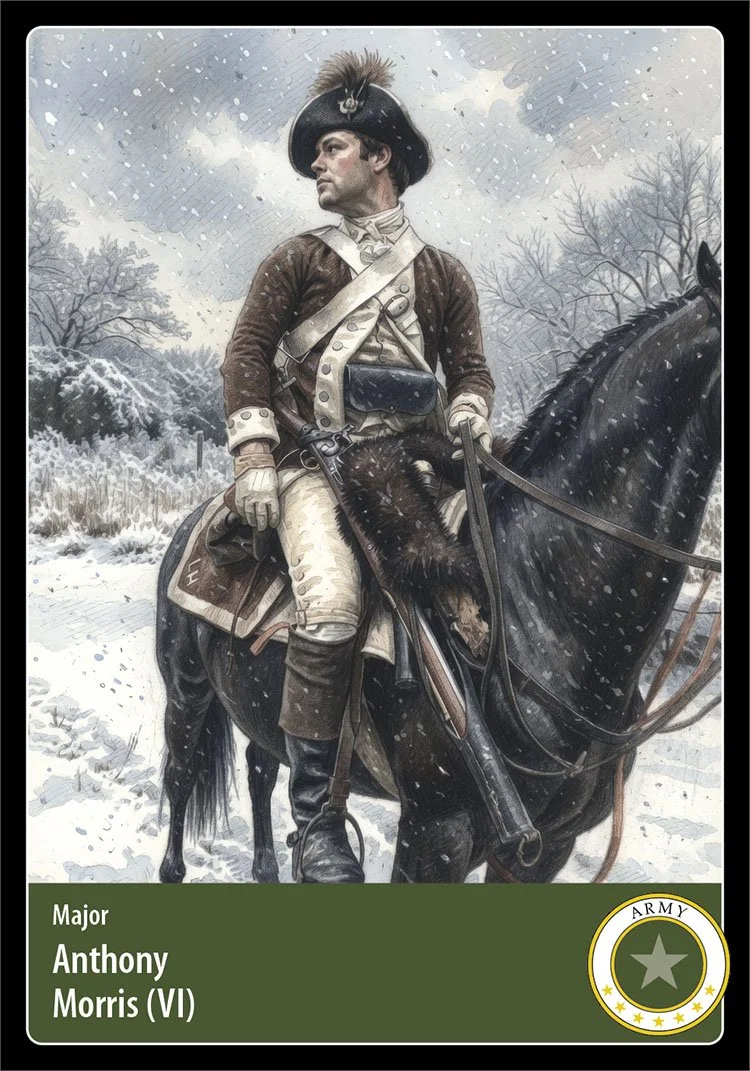
Hero Card 302, Card Pack 26 [pending]
Artist's impression by Craig Du Mez
Hometown: Philadelphia, PA
Branch: Continental Army
Unit: Philadelphia Troop of Light Horse
Date of Sacrifice: January 3, 1777 - KIA in Princeton, New Jersey
Age: 38
Conflict: Revolutionary War, 1775-1783
Born on August 8, 1738, to a prominent Philadelphia family, Anthony Morris (VI) gave his life for the cause of freedom in the Revolutionary War’s Battle of Princeton.
He came from a long line of men bearing the same name. According to George Norbury MacKenzie’s Colonial Families of the United States of America, Morris’s great-grandfather, Anthony Morris II, a merchant and Quaker, settled in Philadelphia in late 1685 after surviving both the bubonic plague and the Great Fire of London.
The Morrises arrived in Pennsylvania four years after England’s King Charles II granted William Penn the charter for a proprietary colony on the North American continent. By 1703, Anthony Morris II was elected Mayor of Philadelphia.
Morris’s grandfather (III) was a prominent Philadelphia brewer, a Representative in the Assembly of the Province of Philadelphia, and a Justice in the City Court.
His father, Anthony Morris IV, joined the brewing business and married Sarah Powell. Anthony and Sarah would have seven children together. The first, Anthony Morris V, died at the age of 1 in 1732. The Morrises named their fourth child Anthony (VI), to carry on the family name.
Anthony (VI) had six siblings—Anthony V, older brother Samuel, older sister Deborah, and younger siblings Israel, Sarah, and Thomas. He also had three half-brothers from his father’s second marriage: William, Luke, and Isaac Hudson.
Morris (VI) volunteered to serve in the new Continental Army, in the Philadelphia Troop of Light Horse (also known as the First Troop Philadelphia City Cavalry). The cavalry unit was commanded by his older brother, Captain Samuel Morris, and served as General George Washington’s bodyguards.
Major Morris’s Philadelphia troop distinguished itself in the Battle of Trenton, after General Washington’s Continental Army famously crossed the icy Delaware River on a dark Christmas night in 1776.
Following a disastrous New York campaign and his famous escape, Washington’s army surprised a garrison of British-hired Hessian troops at Trenton, New Jersey on December 26, 1776. The dawn attack resulted in an unlikely and much-needed American victory.
A week later, on January 3, 1777, Washington “snatched victory from the jaws of defeat and proved his amateur army could defeat the British” at the Battle of Princeton, according to American Battlefield Trust:
The Battle of Princeton was a classic meeting engagement, both sides stumbled into one another, and neither expected to fight on the ground where the battle raged. Initially, the British commander Charles Mawhood marched his force south towards Trenton to meet the main British army, when he spotted the American column. Washington had stolen a march on Charles Lord Cornwallis, slipping away from the British forces along Assunpink Creek the night before.
American victories at Trenton and Princeton changed the course of the Revolutionary War, giving confidence to Continental Army soldiers and hope to the new nation.
But victory is not without cost. A report on the Battle of Princeton by Dr. Jonathan Potts describes the loss of Major Anthony Morris (VI), who was mortally wounded while leading a charge on January 3, 1777:
Tho’ the Acc’t I send is a melancholy one (in one respect), yet I have sent an Express, to give you the best Information I can collect. Our Mutual friend Anthony Morris died here in three hours after he received his wounds on Friday morning. They were three in Number, one on his chin, one on the knee, & the third and fatal one, on the right temple, by a grape shot. Brave Man! he fought and died nobly, deserving a much better fate.
Another doctor, Dr. Enoch Edwards, recorded a list of Major Morris’s possessions. In the archives of The American Revolution Institute at the Society of Cincinnati, it is the only known list of a Continental soldier’s uniform and other items:
A List of Goods belonging to Anthony Morris dec’d
One Regimental Coat
A Blanket Surtout
One Waiscoat [sic]
A Pair of Leather Britches
One Pair of Shoes
A Wig – Catridge Box
a Bayonet Belt & gun Case
2 Silk Handkerchiefs
a fur Cap & pair of Mittens
a Black Stock, a Tobacco Box, 2 Knives & forks
A Pair of [illegible] & Shoe Buckles & [illegible] 3 Keys
Gold Sleeve Buttons
a Silver Watch
77 Dollars & 2/3
3 Flints
Rec’d of Thos: [Illegible] the above articles belonging to Anthony Morris – to be deliver’d to his Friends
at Philad. Jany. 11, 1777 En. Edwards.
Major Anthony Morris (VI) was first buried in the graveyard of the Stone Quaker Meeting House, near the battlefield. At the request of his family, Morris’s remains were later returned to Philadelphia and reinterred—without military honors—at the Religious Society of Friends (Quakers) Arch Street Meeting House burial grounds.

Sources
Artist’s Impression: Craig Du Mez
Colonial Families of the United States of America, Volume VII: Morris Family, p. 357
Appleton's Cyclopedia of American Biography Vol. 4, p. 409: Morris, Anthony
Robert C. Moon, M.D.—The Morris Family of Philadelphia | Descendants of Anthony Morris
Fort Ticonderoga: Heritage, Harvest and Horse Festival Philadelphia Light Horse Guidelines
American Battlefield Trust: Princeton
George Washington’s Mount Vernon: 10 Facts about the Battle of Princeton
Library of Congress: Death of Anthony Morris, Letter of Dr. Potts to Owen Riddle
American Battlefield Trust: A List of Goods Belonging to Anthony Morris
Burial Site: Religious Society of Friends (Quakers) Arch Street Meeting House burial grounds

