

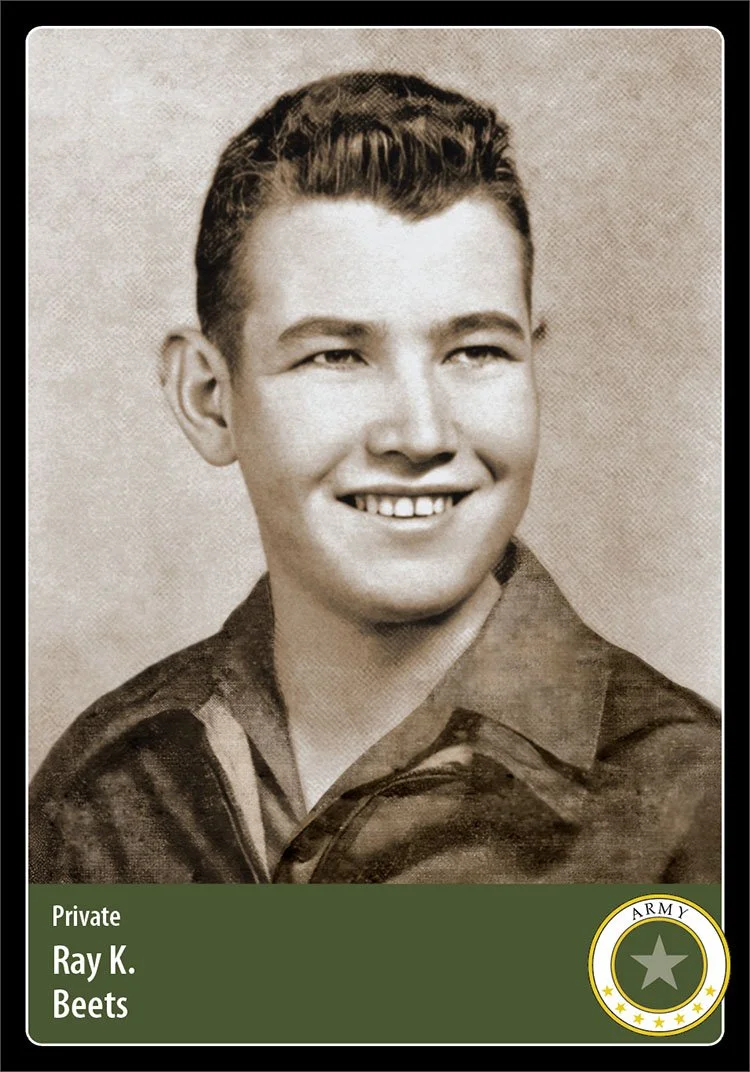
Hero Card 303, Card Pack 26 [pending]
Photo digitally restored from newspaper photos
Hometown: Morristown, TN
Branch: U.S. Army
Unit: Company K, 3rd Battalion, 398th Infantry Regiment, 100th Infantry Division
Military Honors: Purple Heart
Date of Sacrifice: January 2, 1945 - KIA near Bitche, France
Age: 18
Conflict: World War II, 1939-1945
Ray Beets was the fourth of five sons born to Henry Edgar “Ed” and May (Rich) Beets: Henry, known by his middle name “Paul,” Harrell, Bob, and Bill. The family lived in the small Tennessee town of Bean Station, where Ray was born on February 2, 1926.
Ray’s father owned and operated the H.E. Beets General Store in Bean Station, Tennessee. He also owned farmland in the area. Bean Station, the store, the farm, and the family home were submerged under Cherokee Lake after the completion of the Cherokee Dam in 1942. The small community of Bean Station was shifted northward and uphill to higher ground.
Beginning in 1940, the hydroelectric Cherokee Dam was built on the Holston River by the Tennessee Valley Authority. The TVA would supply electricity for factories that churned out an unprecedented number of airplanes, ships, and bombs for America’s war machine during World War II (1939-1945).
Displaced by the dam’s construction, the Beets family moved to nearby Morristown, where Ed opened H.E. Beets & Sons general merchandise store. Young Ray also worked a paper route and got to know the residents well. He joined the Boy Scouts and attended the First Methodist Church.
With America at war, Ray enlisted in the U.S. Army during his junior year at Morristown Senior High School, joining in April of 1944.
Three of Ray’s brothers were already serving: Paul was a Navy lieutenant in the war’s European Theater, Harrell was an Army Air Corps sergeant in the Pacific Theater, and Bob served as a sergeant with the Army Transportation Corps in New Guinea. Youngest brother Bill was in high school and was too young to serve.
At the age of 18, PVT Ray Beets traveled to Camp Shelby in Mississippi for training. By October of 1944, he was assigned to Company K, 3rd Battalion, 398th Infantry Regiment, 100th Infantry Division and sent to the European Theater of Operations.
“Over There”
The 398th’s trip overseas was detailed in the book, History of the 398th Infantry Regiment in World War II:
On 25 September 1944 the 398th packed up and moved to Camp Kilmer, New Jersey, where it was readied for overseas shipment. On 6 October it embarked on the USS General William H. Gordon (AP-117); after fourteen days on the high seas, in which the convoy was buffetted [sic] by a hurricane and generally strong winds, the weary troops were put ashore at Marseille, France.
At this point in the war, Allied forces were successful in pushing the German Army out of Nazi-occupied France—but at a very high cost in lives and materiel. France was being liberated, and the Allies looked to push Hitler’s army far back into Germany, all the way to Berlin.
PVT Beets and his 398th arrived in France on October 20, 1944. Ready to join the fight in eastern France’s Vosges Mountains region, Beets’s regiment was tasked with keeping the retreating German forces in disarray, and later with setting up defenses near the French-German border to prevent their return.
After staging for ten days in the town of Septèmes, the 398th endured rain, cold, snowy, wet conditions as they moved near the French towns of St. Gorgon, St. Barbe, and Raon-l’Etape.
In early November 1944, Beets’s regiment attacked and captured the town of Etival— establishing defenses from counterattack and holding it for four days. The counterattack never came.
After pushing across France, the 398th advanced to the strategically important French city of Bitche, near the German border. Many believed Bitche to be the key in breaking the German defenses and bringing the war in Europe to an end.
The 100th Infantry Division fought through the formidable Maginot Line defenses at Bitche beginning in early October 1944, finally achieving victory in March of 1945.
In that fight to liberate the people of France, on January 2, 1945, Ray Kyle Beets was declared Missing in Action. He was later confirmed to have been killed on that day, at the age of 18, four months before Nazi Germany’s unconditional surrender to the Allied forces.
In a May 7, 1946, letter to PVT Beets’s mother, Ray’s platoon sergeant—Gordon E. Spinney—described what happened on a hillside that Company K was trying to defend from German counterattack:
At that time there was snow on the ground and we were wearing our reversible parkas white in color. As the Germans advanced, Ray found a hole that had already been dug and dove into it. The contrast between the white coat and the brown dirt made him a target for a German bullet. He was hit in the shoulder and as things began to work fast the boys had to withdraw or try to escape capture. Ray must have been stunned so that he couldn’t run and that was the last anybody saw of the boys.
PVT Beets was laid to rest in France, with his fellow soldiers, at Lorraine American Cemetery (Plot A, Row 24, Grave 32).
His service and sacrifice are honored at the East Tennessee Veterans Memorial in Knoxville, where his name is inscribed (Pillar IX, Top Panel).

Sources
Details provided by Mr. Joe Beets, Mrs. Barbara Combs, and Mrs. Becky Covey (PVT Beets’s nephew and nieces)
The Bristol News Bulletin, Jan. 15, 1945: Local Boys in Famed 398th Division
Morristown Gazette and Mail, Mar. 21, 1945: Awarded Combat Badge
Morristown Gazette and Mail, Aug. 27, 1945: Lt. Henry Paul Beets Expected Home
Fields of Honor Foundation: Memorial—Beets, Ray Kyle
U.S. Army Divisions: 398th Infantry Regiment
The George C. Marshall Foundation: History of the 398th Infantry Regiment in World War II
Sunday Gazette and Mail, Oct. 13, 1946: Letter from Office of Adjutant-General Confirms Death of Private Ray K. Beets
East Tennessee Veterans Memorial: Ray K. Beets
Burial Site: Find A Grave

